
The Mindset Behind a $42.5 Million Settlement
In the debut episode, Brian sits down with Austin trial lawyer Trent Kelly to unpack the mindset behind a $42.5 million wrongful death result — from a childhood in rural Arkansas to refusing to trade a client’s outcome for his own comfort.
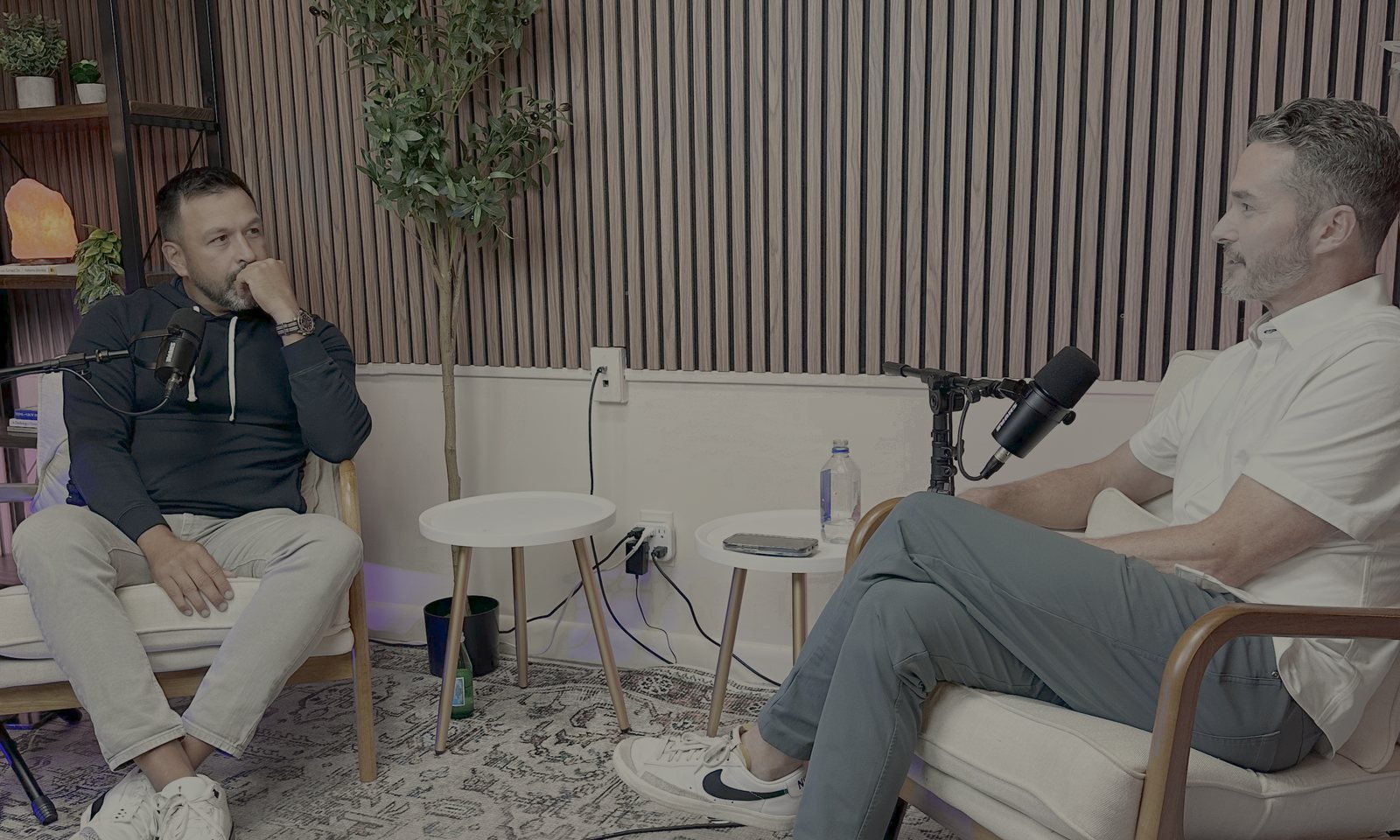
Every skyline starts as one person’s idea. Brian opens the first episode of Elite Mindset with why he started the show: the best conversations about how exceptional people think usually die on the golf course or at the dinner table. This is where they get recorded.
His first guest is Trent Kelly, founder of TK Injury Lawyers in Austin. Trent grew up with nothing in a small Arkansas town and built a chip on his shoulder that he now carries into every case. They talk about why knowing the law is a commodity and character isn’t, why so many lawyers settle for a fraction of a case’s value to avoid discomfort, and why Trent left a comfortable salary — with a two-month-old at home — to bet on himself.
The conversation runs through Kobe Bryant’s 60-point farewell, Jocko Willink’s “Good,” playing golf in the rain as a 13-year-old, and the weight of carrying every client’s worst day. It closes on the case itself: how listening to his clients, refusing to lock in a strategy, and uncovering a driver’s ignored history of excessive speeding led to a $42.5 million result for a family who lost a husband and father.
Embrace the fear
Trent calls it the cornerstone of an elite mindset. Most people never get the outcome they want because betting on themselves is scary. The good stuff is on the other side of it.
Turn disadvantages into advantages
Growing up without the head start other people had became the fuel. “I’m going to refuse to let someone else dictate the outcome for me.”
Don’t trade the outcome for your comfort
Lawyers who sell a case cheap are usually hedging their own risk — time, expenses, uncertainty — instead of their client’s. Trent takes on the discomfort so the client doesn’t pay for it.
The grind happens when no one’s watching
We explain Kobe away as gifted because it protects our egos. The real explanation is the hours before and after everyone else, compounded over a career.
Say “good”
Rained out? Good — now you can train. Borrowed from Jocko Willink, it turns every setback into something you can use. Trent played golf in the rain at 13 for exactly that reason.
Only take what you can add value to
When a caller doesn’t need a lawyer, Trent tells them — and spends 30 minutes mapping out what to do instead. Some of the firm’s best reviews come from people it never represented.
“I couldn’t lay my head on my pillow at night and go to sleep knowing that I sacrificed some outcome for my comfort.”
So, welcome to the Elite Mindset Podcast. And I want to give a little bit of context, context for why I started this pod podcast, why it's something that I think is really important to me, and why I hope it's something that people find value in. Is one of the things that I think about all the time when I drive past cities. Every city has like a different cityscape, right? Where you, you know, if you've traveled and you've been around cities, whether it's America or other places, you can look at a skyline and you can say, hey, that is the Austin skyline, that is the Dallas skyline, that is the Seattle skyline.
And what comprises that skyline is these this eclectic combination of buildings that are all very, very different. And we kind of take for granted that, we take for granted like these architectural marvels that become a city's cityscape. And one of the things I think about all the time, whether it's the Space Needle in Seattle, the Empire State Building in New York, is I think about how that idea started as one person's idea. One person said, I'm gonna build a building that looks like this, the Birch Khalifa, whatever it may be. And then that one person took that idea and they brought all these people together and they created something that now became like a permanent fixture in an entire community and an entire society.
And yet it all emanated from one person and one person's thought. And if you take that concept and you apply it to everything in life, it's also true. Literally every single thing, this microphone that I'm speaking into, the camera that I'm looking at right now, everything emanated from one person thinking something, believing it could happen. And then they went and made that a reality. And what I am fascinated by, I'm getting I'm energized, I'm inspired by is talking to people who, starting with their mindset, create exceptional outcomes. And that's really what this podcast is about. Is I've been privileged enough to know a lot of people who've done things like this, done exceptional things, created exceptional outcomes for themselves and for others.
And yet those conversations, they die on the golf course. They die at a dinner table. Um, and it's great. It's great to have that information. But what I want to do is I want to invite people that I know on this podcast, talk to them, understand their mindset, and to share that with other people. Um, because I find that it's inspiring, I find that it's motivating for myself, and I think it's something good for us to think about is how do we cultivate a mindset that's gonna help us get the outcomes that we want out of life? So I'm excited. My first guest is a longtime friend.
He started off as a client, has become a friend of mine. Trent Kelly's a personal injury lawyer based out of Austin, Texas. In my opinion, one of the best lawyers in the area. Um, and all these things that I just talked about, I feel are true of him. So I feel like he's a great person to have as my first guest guest on the podcast. So, Trent, welcome. Thank you for coming on and being my first guest.
I appreciate that. And I think that's a great introduction. Um, I'm honored to be your first guest. I value the same things you do. I I know we've had a lot of discussions about this off-camera about elite mindset and how people achieve great outcomes through perseverance and originality and really just being themselves, being the true version of themselves. Uh, so I'm happy to be here with you today in your first episode to explore those topics and dig into that, like in a general sense, and also talk about how it impacts my practice and what we do at TK Injury Lawyers.
Awesome. Well, let's get going, man. So um, and I'm gonna obviously we're gonna talk about stuff that I already know, conversations that we've had, but I want to share this with other people as well. Tell me, you know, there's a lot of personal injury lawyers, right? You could throw a rock out the window and hit eight personal injury lawyers who are looking for people who are injured to help represent them. Anyone in America, especially, knows that that's the case. Tell me a little bit about you. Like what was your journey? How did how did it how did how did you end up here? How did you become Trent Kelly, the the personal injury trial lawyer?
Yeah. So I think the story of how I became a lawyer and the story of our firm's success and how we approach cases is really kind of all the same story because it starts with like a small boy growing up in rural Arkansas who had nothing, basically, and who cultivated a chip on his shoulder. Because I think from I grew up looking at people who I felt like had unfair advantages because of the position they were born into or the position they they had over others, whether it be monetary or whatever, whatever creates that imbalance of power. That's something that has always bothered me from the beginning, as long as I can remember, feeling that there's some kind of injustice in the way uh outcomes are achieved for different people through no fault of their own.
So I think, I mean, you can talk, my parents would tell you that before I was probably 10 years old, I was already saying I was going to be a lawyer. And I think the reason for that is because I saw that one person doing a good job for someone who's in a bad situation has the ability to right the wrongs of that imbalance and bring balance to an otherwise rigged system. And I felt called to do that. And so uh I went to law school with the idea of being a trial lawyer. I never thought about being any other kind of lawyer. Um, I was shocked when I got to law school that like 90% of the people I went to law school with were terrified to enter a courtroom.
You know, like I thought everybody was gonna be a trial lawyer when I went to law school. Um, and so when I got there, it was a little jarring to me that you had all these people who were really focused and wanted to learn the information, wanted to become like scholars of the law. But very few who had the wherewithal and drive who wanted to actually step into the arena and and fight for people, you know, using that knowledge. So I think what I learned in law school was, you know, learning the law is really not that difficult, if I'm being, if I'm being honest.
I think a lot of people can know the law, especially these days where we have so much access to information online. Uh, a lot of principles of law are accessible to lawyers and non-lawyers. Anyone with a computer and a search engine can find out a lot of the information you learn in law school. So, what separates lawyers, in my opinion, and in particular trial lawyers, uh, when they go into practice is their own personal experiences. Like, what guides your moral compass? Like, how do you approach a case based on uh is it about the client? Is it about you and your ego? Is it about your law firm?
For me, based on my experiences, I approach, I'm very client-focused because the chip that I grew up with on my shoulder, I apply that chip to every case, right? And so what separates me in a field of a million screaming lawyers on TV and on billboards is that you don't get someone who just knows the law. Because, like I said, that's that's a almost like a commodity. What you get is someone who cares deeply about the wrong that has that you've suffered and who's gonna take it and make it personal for them and use the chip that I've been carrying my entire life to refuse to lose, essentially.
So let me let me just ask some more questions about this chip, right? Because a lot of people have a chip on their shoulder. Where did that so if I'm understanding what you're saying, it came from basically coming from a rough situation, right? Talk to me about that chip. What cultivated that chip? What went into you developing that chip? I know it wasn't as simple as you saw injustices in the world. I want to know more about that. I want to understand that better.
Yeah, okay. So, like from personal experience, what cultivated the chip was I saw as a child, you know, you you can only focus on the things that you see in front of you. Your universe is really small. But there were things that were happening to people around me, people going on nice vacations that I couldn't go on, seeing things in the world that I thought I might not might not ever see, you know. So it was like, it was this like feeling like when you grow up in a situation like that, especially in a small town where a lot of people don't make it out of that town.
And I'm not judging that. I think small town America is great, and I have a lot of family and friends who still live where I grew up. But for me, I felt like there's more to there's more to my story than what's happening here, right? And I need to find a way to make that story a reality. And so I think the chip was cultivated in that's not gonna happen based on my upbringing, my circumstances, not that's not gonna happen for me. I've got to make that happen, right? And so I used the disadvantages I had as an advantage, essentially, if that makes sense.
Like the things that I saw that were like I didn't have that I wanted, that I thought that I I certainly wanted for my children as when they became the age I was at the time. Um, I felt like I'm gonna have to work really hard my entire life and separate myself because I come from a from an experience or a background where I'm not going to be given any advantages. Yeah. You know, I've got to earn all of this.
And you know, just being candid, right? I wouldn't look at you and think that. Yeah. I wouldn't. I would I wouldn't look at you and be like, man, this guy had to go uphill to get where he's at in life.
Yeah. I I mean, I I'll take that as a compliment. Thank you. Uh but I think if you knew me when I was eight, nine, 10 years old, you would you would get it. And you and I have had these conversations, you kind of know that the the granular details of that. I'm not gonna go into that, but um, you know, it's it's more about a sense of I am I I'm gonna refuse to let someone else dictate the outcome for me.
Clips from this episode
Questions this conversation didn’t answer.
If carrying the weight of every case makes you better at the job, what does it cost you at home — and is that a price worth naming?
Is a chip on your shoulder something you can build on purpose, or only something life hands you?
When does refusing to settle stop serving the client and start serving the lawyer’s pride?